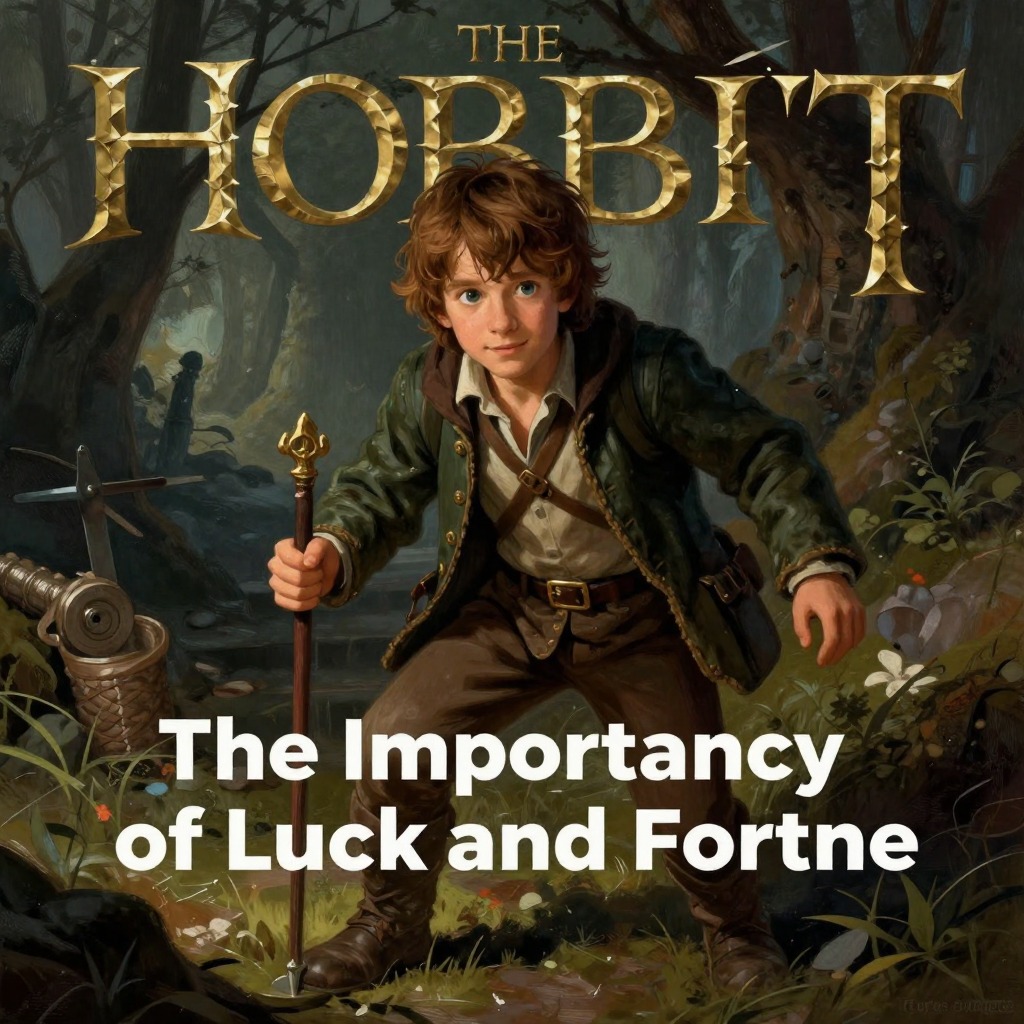
Luck
Luck is the invisible current that carries Bilbo Baggins through the perils of his unexpected adventure, a force so constant that it becomes a defining trait of the hobbit himself. From the moment he stumbles upon a magic ring in the darkness of the goblin tunnels to the final arrow that slays Smaug, luck—often paired with his own growing wit and courage—repeatedly tips the balance between survival and annihilation. The narrative treats luck not as random fortune but as a kind of earned grace, a reward for the Tookish daring that lurks beneath Bilbo's respectable Baggins exterior, and a quality that distinguishes him from the more calculating dwarves.
The Nature of Luck in the Narrative
The story establishes luck as an active, almost magical property from its opening pages. Bilbo's very existence is framed as a product of fortunate inheritance: his mother Belladonna Took was one of the three remarkable daughters of the Old Took, and it is from this side that he inherits "something a bit queer" that waits for a chance to come out. The narrator explicitly notes that Bilbo was "born with a good share of it" when he guesses the right direction to find the captured dwarves in Mirkwood. This luck is not passive; it is repeatedly linked to action and decision. When Bilbo, lost and alone in the goblin tunnels, blurts out "Time! Time!" as a desperate answer to Gollum's riddle, he is saved "by pure luck"—but that luck only arrives because he has engaged in the riddle-game at all. The ring itself, a "turning point in his career," is found by accident when his hand meets "a tiny ring of cold metal lying on the floor of the tunnel," an event that occurs only because he has been separated from the dwarves and is groping in the dark.
Luck as a Character Trait and Narrative Reward
As the adventure progresses, luck becomes increasingly identified with Bilbo's personal growth. After he kills the giant spider in Mirkwood, the dwarves praise him so much that he begins to feel "there really was something of a bold adventurer about himself after all, though he would have felt a lot bolder still, if there had been anything to eat." The narrator explicitly links his three most useful possessions: "some wits, as well as luck and a magic ring." Thorin himself acknowledges this quality, calling Bilbo "a hobbit full of courage and resource far exceeding his size, and if I may say so possessed of good luck far exceeding the usual allowance." This luck is not a cheat code but a reflection of his character: it is the Tookish part of him that dares to step forward, and the Baggins part that thinks before acting. Even Gandalf, when Bilbo returns to the camp after the battle, exclaims, "I began to wonder if even your luck would see you through!"—implying that luck is a known quantity, a kind of credit that Bilbo has accumulated.
The Limits and Costs of Luck
Yet the story is careful not to make luck an absolute guarantee. Bilbo's luck has limits, and it comes with costs. The same fortune that allows him to find the ring also leads him into the most terrifying moments of his life, from the confrontation with Gollum to the face-to-face meeting with Smaug. His luck does not prevent the death of Thorin, Fili, and Kili in the Battle of Five Armies, nor does it spare him from the loss of his reputation among the respectable hobbits of the Shire. The narrative makes clear that luck must be partnered with courage and wisdom. When Bilbo stands alone in the tunnel before the dragon's lair, the narrator states that "going on from there was the bravest thing he ever did. The tremendous things that happened afterwards were as nothing compared to it." Luck may open the door, but it is courage that walks through it.
Thematic Significance: Luck as a Moral Force
Ultimately, luck in The Hobbit functions as a moral and thematic force that rewards the right kind of character. Bilbo's luck is not the luck of a gambler but of a person who, despite his fears, consistently chooses to help others, to keep his word, and to act with decency. It is the luck that allows him to escape the goblins, to win the riddle-game, to rescue the dwarves from the spiders, and to discover Smaug's weak spot. It is also the luck that brings the eagles at the last moment and that allows him to return home—changed, but alive. The story's final image of Bilbo, happy and content in his hobbit-hole, writing his memoirs and visited by old friends, is a testament to the enduring power of that luck. As Gandalf tells him, his adventures were not managed "by mere luck, just for your sole benefit," but as part of a larger pattern in which a "very fine person" and "quite a little fellow in a wide world" plays a part far greater than himself.